
The Enterprise AI Stack of 2026: Knowledge, Data, Agents & Governance
By 2026, most enterprises will stop asking whether AI is important. That debate is already over. The real question now is more uncomfortable: why does so much AI still fail to scale?
Despite massive investment, research from MIT, Gartner, and IDC consistently shows that 70–90% of enterprise AI initiatives never make it into sustained production. Not because models don’t work, but because the enterprise stack underneath them wasn’t designed for AI in the first place.
What’s emerging instead is a clearer picture of what a production-ready AI stack actually looks like. And it’s very different from the “model + data lake + dashboard” architecture most organizations are still clinging to.
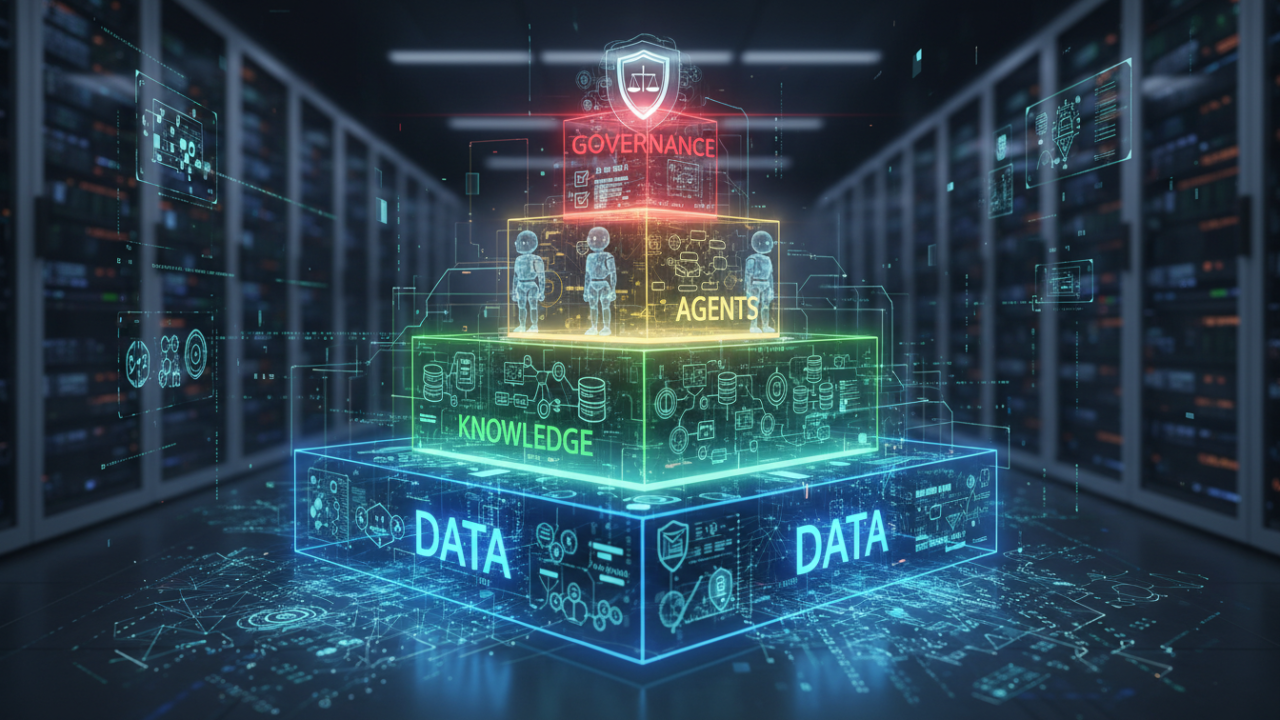
The enterprise AI stack of 2026 rests on four tightly connected pillars: knowledge, data, agents, and governance.
1. Knowledge: The Missing Layer Most AI Stacks Ignore
Enterprises don’t suffer from a lack of data. They suffer from a lack of shared understanding.
Critical business knowledge lives across documents, tools, emails, intranets, tickets, and human memory. When AI systems can’t access or reason over this knowledge, outputs feel generic, ungrounded, or worse, confidently wrong.
This is why research increasingly points to enterprise knowledge unification as a prerequisite for trustworthy AI. The 2026 stack treats knowledge as a first-class layer, not an afterthought. AI systems are grounded in both authoritative and non-authoritative sources, enabling context-aware reasoning rather than surface-level responses.
In short: if AI doesn’t understand how your enterprise works, it can’t improve how your enterprise works.
2. Data: From “Clean Enough” to Intelligence-Ready
For years, organizations have focused on cleaning data. That’s no longer sufficient.
Gartner research shows that a majority of AI failures stem from poor data readiness, not poor algorithms. Data that is technically clean but semantically inconsistent, poorly governed, or disconnected across domains still breaks AI at scale.
The 2026 AI stack replaces passive data platforms with agentic, semantic data foundations. These platforms automate ontology mapping, enrichment, quality checks, and compliance controls, making data continuously ready for AI consumption.
This shift matters because AI systems don’t just query data. They reason over it. And reasoning collapses when data lacks context, lineage, or trust.
A Different Approach: Where Radiant Digital Stands Apart
Most AI providers start with models - and figure out enterprise realities later. Radiant Digital takes the opposite path.
Our Applied AI approach starts with the enterprise itself: how knowledge flows, how data is governed, how systems operate, and how people actually work.
This means building an AI that's operationally viable, not just impressive in a demo. From AI-native Knowledge Hubs and Agentic Data Frameworks with embedded governance, to AI-first SDLC, AI-Ops, Intelligent CX, and secure Conversational AI, every capability is designed for production, not proof-of-concept.
The goal isn't novelty. It's readiness, trust, and scale.
3. Agents: From Insights to Execution
A critical evolution in the 2026 stack is the rise of AI agents.
Insights alone don't change outcomes. Execution does. Research from IDC highlights that AI delivers value only when it's embedded into workflows - not when it sits on the side as a recommendation engine.
Agents bridge that gap. But not all agent architectures are equal.
Radiant Digital's approach is built on purpose-built micro agents - small, specialized agents designed for specific personas and tasks - paired with multi-agent orchestration for complex, cross-functional workflows. Instead of one monolithic agent trying to do everything, micro agents handle discrete responsibilities: a compliance agent, a data validation agent, a customer response agent, each expert in its domain, each governed independently.
When tasks require coordination across systems, knowledge, and decisions, orchestration layers bring these agents together - reasoning collectively, acting in sequence, and escalating to humans only when necessary.
This isn't AI as an advisor. It's AI as an active, governed participant in enterprise operations - removing friction, automating routine actions, and accelerating response cycles without replacing decision-makers.
4. Governance: The Difference Between Trust and Chaos
Governance has quietly become the most important layer of the enterprise AI stack.
According to multiple industry studies, organizations with mature AI governance are significantly more likely to achieve measurable ROI from AI initiatives. Yet most enterprises still treat governance as something to bolt after deployment.
In the 2026 stack, governance is embedded end-to-end:
- data quality and compliance at ingestion
- traceable reasoning and explainability in AI outputs
- observability across agents and workflows
- controlled evolution of models and systems
This isn’t about slowing innovation. It’s about enabling AI to scale without triggering risk, compliance, or trust breakdowns.
What Enterprise Readiness Really Means
Enterprise readiness isn’t about having the latest model or the biggest data lake. It’s about having an AI stack designed for reality.
One where:
- Knowledge is unified and accessible
- Data is intelligence-ready, not just stored
- Agents execute within governed boundaries
- Operations can support AI at scale
By 2026, the winners won’t be the companies that experimented with the most. They’ll be the ones who built AI systems meant to last.
If your AI initiatives keep stalling after the pilot phase, the issue isn’t ambition; it's architecture. It may be time to reassess how your AI roadmap is designed. Connect with Radiant Digital’s AI experts to move beyond experimentation.
Relevant Articles

Enablers

Discover improved customer experience, productivity, and ROI.


Scalable, secure, and agile cloud infrastructure is taking the industry by storm.

Envisage a steady stream of insights through transparent, accessible data.